Tips & tricks for a successful change of food

Would you like to switch to high-quality food, but don't know exactly how to go about it? Don't worry! «My cat is picky» is something we hear a lot - and you're not alone. In this article, we would like to leave you with some valuable tips on how to make a successful change of food.
Before you start changing your cat's diet, you should know the following: getting a cat off conventional food with sugar, attractants and artificial additives usually doesn't work overnight. At the end of the procedure, the question arises as to who had the more stamina - you or your furry sly cat. ?
«Endurance is concentrated patience»
Thomas Carlyle, Scottish philosopher and historian
(1795 - 1881)
Why doesn't my cat just eat the new food?
In the rarest of cases, a change of food works from one day to the next. This is because „cats don't eat what they don't know“. And for a very simple reason: in the wild, it is dangerous for a cat to eat something it does not know. As «neophobics», cats are generally afraid of anything new. This keeps them away from poisonous plants or animals in the wild. This is why cats stick to what they have learned to eat well at some point.
When planning a change in diet to high-quality cat food Without attractants, grains, or sugar, this is, of course, of little help.
We must therefore help our cats to get to know new food and learn that it is not dangerous. Incidentally, even once the cat has been switched, it must always be assumed that the same problems could arise with new varieties and that a careful changeover must be carried out.

How to make the new food tasty for your cat
If the attempt to give your cat the new food 1:1 has failed and your cat has walked away „nasally“, we recommend that you use the „substitution method“:
Mix the cat's familiar food with approx. 5 % of the new food. This works well with a fork, so you can mix it well together.
Once your cat has eaten its usual food well with the small amount of new food, you can increase the amount of new food again slightly at the next meal. However, only do this in small steps to protect your cat's stomach on the one hand and to prevent it from turning its nose up again on the other.
Tip
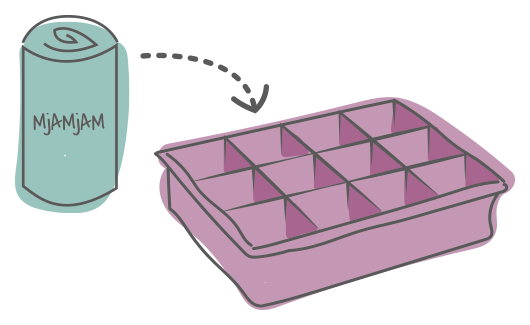
Wet food can only be kept in the fridge for a few days. So that you don't have to throw away huge amounts of new food, we recommend freezing the new food in small portions using an „ice cube maker“.
Defrost the small cubes early enough (approx. 30 minutes before feeding time) so that the food is at room temperature again before you feed it to your cat.
Trial packs for a successful change of food
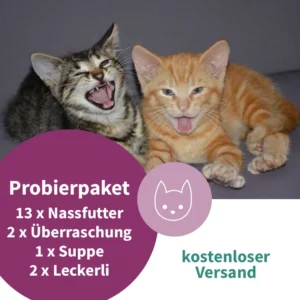
Not sure yet which food might work for your cat? No problem! We have a variety of Tasting packages for cats compile and send them free.
-















 Kitten
ARTGERECHT. Tasting package - 16 articles - KITTEN
CHF 36.90 -




















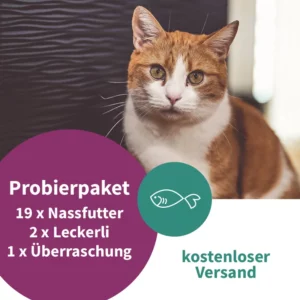 Adult
AdultARTGERECHT. Tasting package - 21 articles - with fish
CHF 45.00 -





















 Adult
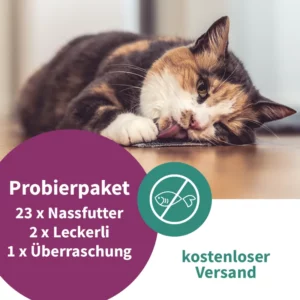
AdultARTGERECHT. Tasting package - 25 articles - without fish
CHF 54.90















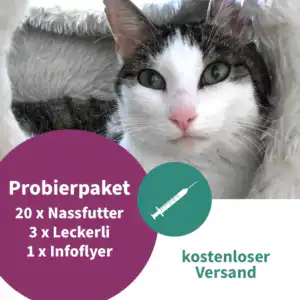
Sample Pack for People with Diabetes
We now also offer a sample pack for people with diabetes compiled.
Often, when you first receive this diagnosis, it can be overwhelming, and you’re recommended to switch to a special diet or diabetic food. But the good news is: In most cases, that’s not necessary at all! Find out more in our blog post A «Diabetes» Diagnosis and What You Should Know About It, how you can cope with the diagnosis, and what's important to keep in mind!
This sample package includes a handout containing the information we have compiled and researched on the topic of «diabetes.».
Further tips
- Do not feed treats during the changeover period and stick to fixed feeding times during this time
- Avoid dry food altogether
- Feed adult cats 3-4 times a day and young cats at least 5-6 times a day (or simply: all you can eat)
- Avoid so-called hunger breaks of more than 12 hours, as this can lead to health problems
- Add a little water to the wet food, this promotes fluid absorption and provides a bit of sauce at the same time
- For a peaceful night's sleep: feed your cat again before you go to bed
- Winter is better suited to a change of food than summer, as cats generally like to eat more in winter and outdoor cats find fewer mice and birds
Do you have any tips?
Have you already successfully converted your cat and still have some tips to share? We are always interested in hearing more tips that we can pass on to our customers. After all, this topic is not an easy one. Please write to us an e-mail with your favorite tips & tricks!
zurück zur Übersicht

